

Best Intercooler for Evo X: Buy Once, Fit Right
Heat soak is the Evo X’s quiet power thief. You feel it when the car rips in third, then the next pull is flatter—even if boost looks the same. That’s charge temps climbing, timing getting pulled, and the turbo working harder than it should. If you’re shopping for the best intercooler for Evo X, you’re really shopping for consistency: repeatable power, safer air temps, and a setup that fits your build without turning the front bumper into a fabrication project.
What “best intercooler” actually means on an Evo X
“Best” depends on how you use the car and what turbo you’re feeding. A front-mount intercooler (FMIC) is a heat exchanger and an airflow restriction at the same time. Go too small and you’ll heat soak; go too big and you can add pressure drop and lag, plus create fitment headaches and block too much radiator airflow.
On the 4B11T, intercooler choice also affects knock resistance and tuning headroom. Lower, steadier intake air temps let your tuner run more stable ignition and avoid the rollercoaster effect where the first pull is great and the third pull is a compromise. The “best” unit is the one that keeps temps in check at your power level, with minimal pressure drop, with end tanks and piping that don’t fight the car.
The baseline: stock Evo X intercooler vs. reality
The factory Evo X intercooler is fine for a stock car and mild bolt-ons, but it becomes the bottleneck fast once you start leaning on the turbo or running repeated pulls. You’ll typically see:
Heat soak after a couple of back-to-back hits, especially in warm weather.
Rising intake temps that force the ECU/tune to protect the engine.
A ceiling where “more boost” just makes more heat, not more useful oxygen.
If your build is truly near-stock and you do one highway pull here and there, you can delay the intercooler upgrade. But most Evo X owners aren’t building these cars to do one pull.
The two intercooler decisions that matter most
Core style: bar-and-plate vs. tube-and-fin
For most Evo X performance builds, bar-and-plate is the move. It’s heavier, but it handles repeated heat load better and tends to be more durable against road abuse. Tube-and-fin can be lighter and can flow well, but it’s generally less tolerant of sustained heat and repeated high-boost runs.
If you want a track-day intercooler that doesn’t fall on its face after two laps, bar-and-plate usually wins.
Size: “bigger” is not automatically faster
Core size needs to match airflow. A larger core can reduce charge temps, but if it’s oversized for your setup, you can trade response for bragging rights. The goal is efficient cooling with reasonable pressure drop.
Here’s a practical way to think about it:
A street Evo X on the stock-frame turbo or a modest upgraded turbo typically wants a mid-size core with good end tanks and 2.25–2.5-inch piping.
A higher-power setup (larger turbo, higher boost, sustained track pulls) benefits from a larger core, but you should expect tighter packaging and more attention to ducting and radiator temps.
Fitment: the most under-rated “performance mod”
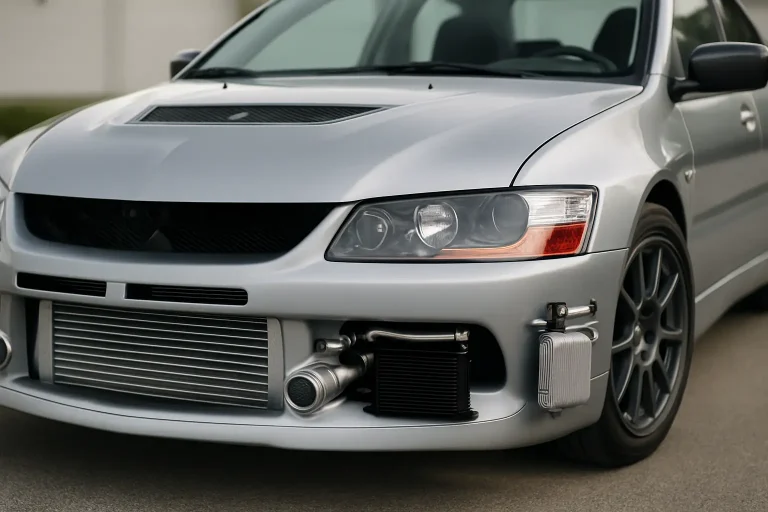
A perfectly designed core that doesn’t seal to airflow is leaving power on the table. Likewise, a kit that “almost fits” can turn into boost leaks, rubbed-through couplers, or a bumper beam hack job that you regret later.
On an Evo X, pay attention to:
Bumper beam compatibility. Some kits require trimming or replacing the crash beam. Decide up front how you feel about that.
End tank design and outlet placement. Smooth transitions matter for flow and consistent boost control.
Coupler and clamp quality. Many “mystery kits” make power on paper but become leak-chasing exercises.
Clearance around the A/C condenser, radiator, and fog/bumper plastics. You want airflow, not a packed front end that heat-soaks everything behind it.
If you’re building a car you actually drive hard, fitment isn’t cosmetics—it’s reliability.
What we recommend by build goal (without the fluff)
1) Stock turbo or mild bolt-ons: prioritize response and consistency
If you’re on the stock turbo (or similar airflow) and your goal is a sharper, more repeatable street car, the best intercooler for Evo X is usually not the biggest thing you can squeeze behind the bumper. You want a well-engineered, mid-size bar-and-plate core with efficient end tanks and proven piping routing.
Why? You’ll control temps far better than stock without adding unnecessary volume. The car stays responsive, and you get the biggest real-world gain: the second and third pull feel like the first.
2) “E85-friendly” street build: chase stability, not peak dyno
If you’re running ethanol blends or full E85, you already have knock resistance working for you, but that doesn’t mean intake temps don’t matter. Ethanol can hide problems until you’re heat-soaked and the tune is living on the edge.
A slightly larger core than the mild-bolt-on setup is typically the sweet spot. You’re planning for longer pulls, more boost, and higher airflow, but you still want reasonable pressure drop and solid street response.
3) Big turbo / track use: cooling capacity and airflow management win
Once you’re pushing real airflow—larger turbo, high boost, sustained load—the intercooler becomes a system, not a single part. A larger bar-and-plate core with properly designed end tanks is the right direction, but don’t ignore what happens behind it.
A huge intercooler can block radiator airflow and raise coolant temps, especially on track. That’s not a theory; it’s a common “why is my car running hot now?” moment after a front-end upgrade.
If you’re going big, do it like you mean it: plan ducting, check sealing, and keep the radiator and oil cooling strategy in the conversation.
The common mistakes that make a “good intercooler” feel bad
Oversizing without a power goal
If you’re not flowing enough air to use the extra core volume, you’re paying in response and packaging for minimal temperature benefit. It’s the intercooler version of running a turbo that’s too big for your driving.
Ignoring pressure drop
An intercooler that cools well but drops a lot of pressure forces the turbo to work harder to hit target boost. That adds heat and can reduce efficiency. A well-designed core balances cooling and flow; it doesn’t just act like a cold brick wall in the charge path.
Poor clamps/couplers and “mystery piping”
Boost leaks kill consistency and make tuning annoying. If you’ve ever chased random fuel trims or wondered why boost is “there” but power isn’t, you already know the pain. Quality silicone, good bead rolls, and real clamps aren’t optional on an Evo X you drive hard.
Treating the intercooler as the only cooling upgrade
Charge temps, coolant temps, oil temps—they’re all related when you’re running sustained load. A better intercooler helps, but if you’re stepping into track use or higher power, plan the whole thermal package.
How to pick the right intercooler without guessing
Start with your realistic power goal and how you drive. A daily-driven Evo X that sees spirited pulls wants a different solution than a car doing repeated hot laps or highway pulls at high boost.
Next, decide what you will and won’t cut. If you’re not willing to trim the crash beam or modify the bumper, that narrows the field—and that’s fine. A clean, well-fitting kit that seals properly often outperforms a bigger core installed with gaps and compromises.
Then, talk to your tuner (or your future tuner). Tell them the turbo, fuel, and boost range you’re targeting, and ask what they see working consistently on Evo X cars in your climate.
If you want parts that are vetted specifically for these platforms—no generic catalog roulette—this is exactly the lane we live in at Evo Motor Parts: Evo-only fitment, enthusiast-proven options, and build guidance that respects reliability.
One more nuance: what you feel from the driver’s seat
A good intercooler upgrade doesn’t always feel like “more peak power” on the first pull. It feels like the car staying sharp when it’s hot, when you’re doing repeated runs, and when the conditions aren’t perfect. The best setups make the Evo X feel predictable: boost control steadier, timing happier, power delivery less moody.
That’s the whole point. Anyone can post a single dyno hit. The cars that earn respect are the ones that repeat.
Keep your pick honest: match the intercooler to your airflow, insist on fitment that seals and holds boost, and build for the way you actually drive the car. Your Evo X will pay you back every time you stay in it for one more pull.



One Comment