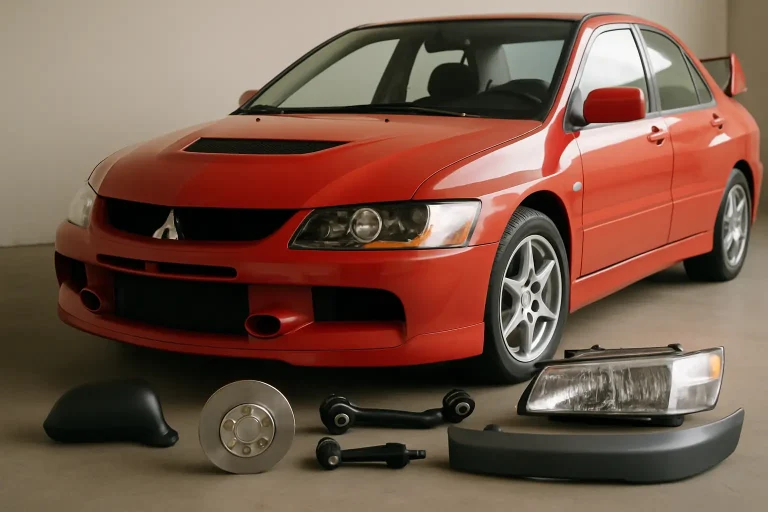
Evo 8 vs Evo 9 Turbo Differences That Matter
The fastest way to start a pointless argument at an Evo meet is to say, “The Evo 9 turbo is just an Evo 8 turbo.” It sounds close enough to be true – until you actually drive two healthy cars back-to-back, log them, and start pushing past basic bolt-ons.
If you care about how the car builds boost coming out of a corner, how hard it pulls from 5,500 to redline, and how long it survives when you lean on it, the turbo differences between the VIII and IX aren’t trivia. They shape the whole personality of the 4G63.
Evo 8 vs Evo 9 turbo differences in one sentence
Both cars use a Mitsubishi Heavy Industries TD05H frame turbo, but the Evo 9’s factory unit is a more airflow-capable variation (most commonly referenced as the “9 turbo” with a larger compressor and improved efficiency), while the Evo 8 turbo is the quicker-spooling, slightly more limited option when you start demanding real top-end.
That’s the headline. The details are where your build either feels sharp and responsive or falls flat up top.
What turbo does the Evo 8 have?
USDM Evo 8s came with an MHI TD05H 16G-style turbo that’s essentially the “8 turbo” everyone talks about. It’s a compact, responsive unit that gives the Evo 8 its punchy midrange. On a stock motor with the usual supporting mods, it’s easy to make a fun street car that hits boost early and feels alive in normal RPM ranges.
The trade-off is that as airflow demand climbs – higher boost, more timing where it’s safe, more RPM – the Evo 8 turbo starts to run out of efficiency. You can still make strong numbers with the right setup, but you’re pushing the turbo harder to do it, which means more heat and less margin.
What turbo does the Evo 9 have?
USDM Evo 9s came with the factory “9 turbo,” commonly associated with a TD05H 16G variant that uses a larger compressor wheel and updated compressor cover design compared to the Evo 8 unit. In real terms, that usually shows up as better breathing at higher RPM and a little more headroom before the turbo becomes a hot air pump.
The Evo 9 also introduced MIVEC on the intake cam, and that matters here because it changes how the engine moves air. The turbo isn’t working in isolation. MIVEC can help the engine carry airflow higher in the band, and the Evo 9 turbo complements that by being less restrictive up top.
Spool and response: where the Evo 8 turbo wins
If your priorities are low-RPM response and that instant shove when you roll into the throttle around town, the Evo 8 turbo has an edge. With similar supporting mods and a sane tune, it generally lights sooner and feels more eager in the midrange.
This is why a clean Evo 8 on a conservative tune can feel “snappier” in casual driving than an Evo 9 that hasn’t been dialed in. The 9 turbo’s extra airflow potential is real, but you often feel it most when you’re actually using the top half of the tach.
There’s no free lunch. More compressor generally means a touch more inertia and slightly later boost onset, even if the difference isn’t massive.
Top-end power: where the Evo 9 turbo pulls away
The Evo 9 turbo’s whole reason to exist is flow. When you’re running the car hard – long pulls, track sessions, higher boost in the upper RPM range – the 9 turbo typically holds power better toward redline.
Practically, that means an Evo 9 setup is more likely to keep climbing where an Evo 8 turbo starts to feel like it’s tapering off. You’ll see it in logs as rising charge temps and a tune that needs more compromise to stay knock-free at the top. You’ll feel it as a car that stops pulling as hard after the midrange hit.
If you’re chasing a broad powerband instead of a midrange punch, the 9 turbo is the better OEM-based starting point.
Efficiency and heat: the difference you feel later
A lot of people only talk about “how much horsepower” each turbo can make. The bigger point is how they make it.
When a turbo is operating in a less efficient range, it generates hotter outlet temps for the same boost pressure. Hotter air raises knock tendency, forces you to pull timing, and increases the workload on your intercooler and cooling system. That’s where the Evo 9 turbo’s improved compressor setup typically helps – not by magically making the car faster at the same tune, but by giving you more room to tune safely as you push the combination.
On a daily driver, this can show up as consistency. On a track car, it shows up as surviving session after session without heat-soak turning your tune into a compromise.
Fitment and swapping: what actually bolts up?
The reason these turbos get compared so often is because the swap conversation is real. Evo 8 and Evo 9 turbo hardware lives in the same family, so physically installing one in place of the other is usually straightforward, but “bolt-on” doesn’t mean “no details.”
Manifold fitment on the TD05H-frame MHI units is generally compatible, and the oil and coolant line routing is similar in concept, but you still need to pay attention to the specific turbo version, the compressor cover outlet orientation, and the wastegate actuator setup.
The smarter way to think about it: treat a turbo swap like a system swap. Budget for the gaskets, the lines or line refresh if yours are tired, and the supporting airflow and fueling changes that keep the car reliable.
If you’re sourcing parts, use a specialist that lives in the Evo platform every day so you’re not playing guessing games with year-to-year quirks – that’s exactly why builders come to shops like Evo Motor Parts.
Tuning differences: why “same boost” doesn’t mean same results
One of the most common mistakes is setting both turbos to the same boost target and expecting a clean comparison. Boost pressure is just resistance to airflow. Two turbos at 22 psi can move very different mass flow, and they can deliver that airflow at very different temperatures.
With the Evo 9 turbo, it’s common to find that the car wants different wastegate duty behavior to hit targets cleanly up top, and the engine may tolerate more timing in the higher RPM range because the compressor isn’t working as hard for the same airflow.
With the Evo 8 turbo, you may end up tapering boost earlier or being more conservative with timing at high RPM to keep it out of knock. That doesn’t make it “bad.” It just means it’s optimized for response rather than sustained top-end.
MIVEC on the Evo 9 adds another layer. Cam control can shift where the engine makes torque and how quickly it spools, so an Evo 9 with the stock turbo and a great tune can feel more flexible than people expect, while a poorly tuned MIVEC map can make the car feel inconsistent.
Reliability and longevity: what changes when you push them
At stock or mild boost levels, both turbos can live a long time if the oiling is healthy, the car is warmed up properly, and the tune isn’t aggressive.
When you raise the stakes, the failure modes start looking familiar: overspeeding the turbo to chase airflow it can’t efficiently provide, elevated exhaust backpressure, and heat management issues. In that context, the Evo 9 turbo’s extra headroom can be a reliability advantage because you’re not forcing the unit to operate as far outside its sweet spot for the same real-world performance.
That said, the turbo isn’t the only limiter. Fuel quality, injector duty cycle, intercooler efficiency, and exhaust manifold condition can make a “better” turbo behave worse than expected. This is why two cars with the same parts list can drive completely differently.
Which one is right for your build?
If you want a fast-spooling street car that feels sharp in normal driving, the Evo 8 turbo is still a solid choice, especially if your goals are modest and you care about response more than dyno graphs.
If you’re building for higher RPM power, plan to run the car hard, or you want more breathing room as you add supporting mods, the Evo 9 turbo is usually the more future-proof factory-based option.
It also depends on how you drive. Autocross and tight back roads reward response. Track days and highway pulls reward top-end stability and efficiency. Your “best” turbo is the one that matches the way you actually use the car.
The most important move isn’t picking the turbo that wins arguments online. It’s choosing the turbo that makes your Evo repeatable: consistent boost control, manageable intake temps, and a tune that doesn’t live on the edge every time the weather changes.
Keep the goal simple: build a setup you can beat on without flinching – and make every part around the turbo strong enough that the turbo isn’t the only thing doing the work.