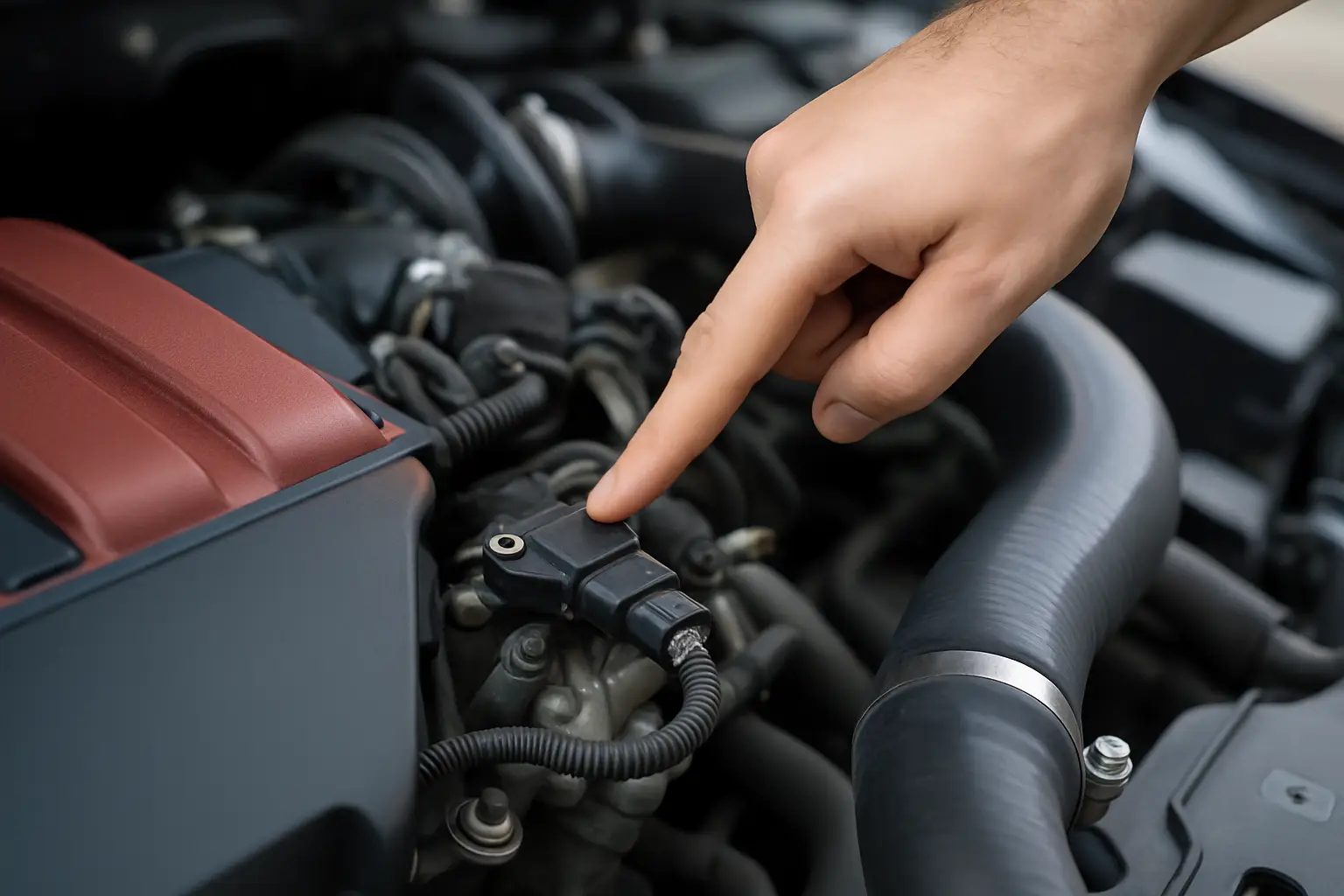
Evo X MAP Sensor Location (and Why It Matters)
If your Evo X suddenly feels flat on boost, throws a P0108/P0107, or your logs show MAP doing weird stuff right when you tip in – you do not need a motivational speech. You need to put your hands on the right sensor, verify it is actually reading pressure, and make sure the ECU is getting a clean signal.
On the Evo X (4B11T), the MAP sensor is one of those parts that is easy to talk about and surprisingly easy to misidentify when you are staring into an engine bay full of hoses, solenoids, and heat shields. Let’s pin down the exact evo x map sensor location, what you are looking at, and the quickest way to confirm you have the right component before you start throwing parts at a problem.
Evo X MAP sensor location: where to look
On a factory Evo X intake setup, the MAP sensor is mounted on the intake manifold, on the top side of the manifold near the throttle body area. It is a small sensor body with an electrical connector and an O-ring seal, bolted directly to the manifold so it can read manifold absolute pressure and temperature (on many applications it is a T-MAP style sensor).
Practically speaking, stand at the front of the car and look toward the throttle body. You are hunting for a compact sensor held in with two small bolts and a 3-pin style connector, seated into the manifold with an O-ring. It is not on the intercooler piping, and it is not down on the block. It lives where pressure is most “real” – after the throttle, in the manifold plenum.
Depending on your exact year and which parts have been swapped over the years, the sensor will still be on the manifold, but access can change a lot. A stock airbox and stock charge piping give you a pretty open shot from above. A big intake, rotated piping, or a custom throttle body elbow can make it feel buried, but the mounting logic does not change: it is reading what the cylinders see.
MAP vs MAF: the mix-up that wastes time
A lot of Evo owners say “MAP” when they are actually thinking of the MAF. The MAF sensor is in the intake tract upstream, reading incoming air mass. The MAP sensor is on the intake manifold reading pressure. If you are looking at the airbox or intake tube and you are holding a sensor with a big plastic housing, you are in MAF territory, not MAP territory.
That distinction matters because the troubleshooting path is different. A dirty MAF can cause weird fueling and drivability. A MAP sensor problem can throw boost control and load calculations off, which can feel like the car hits a wall or surges when it should be pulling clean.
Why the location matters for performance and tuning
On the 4B11T, manifold pressure is a core input for load. Load drives fueling targets, ignition timing, boost control strategy, torque modeling – basically the stuff that separates “runs” from “rips.” When the sensor is mounted on the manifold, it sees true manifold pressure changes during throttle transitions, spool, and shifts. That is exactly why the evo x map sensor location is not negotiable from an engineering standpoint.
If the sensor is installed incorrectly (damaged O-ring, cracked mounting boss, wrong sensor depth, or debris preventing a seal), you can create a tiny leak right at the source of truth. That leak might not whistle. It might not show up on a casual boost leak test. It can still skew readings enough to mess with trims and boost response.
It also matters when you start swapping parts. Big cams, big turbo, or a different manifold can change the shape of pressure pulses and transient response. The sensor needs to be mounted in a spot that gives stable, representative pressure. The factory spot is chosen for that. If a custom manifold relocates the sensor, you want it in the plenum area, not at the end of a runner where pressure fluctuations are more violent.
Getting to it without breaking things
The MAP sensor is small, but the connector and bolts are where people get in trouble.
Most of the time, you can access it from the top with basic hand tools. Let the engine cool. Heat soak plus plastic connectors is how tabs snap. Unclip the electrical connector carefully – do not pry it like you are opening a paint can. Then remove the two bolts and lift the sensor straight out. If it feels stuck, it is usually the O-ring gripping the bore. A gentle twist is better than a yank.
When reinstalling, the sensor should seat smoothly. If you have to force it, stop. A pinched O-ring can create a leak, and an O-ring that rolls can get cut and then you are chasing a “mystery” issue you created.
The small details that make a big difference
Two things decide whether this is a five-minute job or an afternoon of frustration: the O-ring condition and the connector integrity.
If the O-ring looks flat, cracked, or swollen, replace it. If there is oil residue, clean the sensor bore and the sensor tip area gently with electronics-safe cleaner and let it dry. Do not scrape the bore with something that will gouge aluminum. Also, do not over-torque the bolts. You are not sealing with torque. You are sealing with the O-ring.
If the connector tab is loose or the wiring looks stressed, fix that now. A MAP sensor that is perfectly healthy can still signal garbage if the harness is intermittently open. You will see it in logs as random spikes or dropouts that do not match what the engine is doing.
Quick checks before you blame the sensor
MAP problems are famous for sending people straight to the parts cart. Sometimes that is the right move. Sometimes the sensor is doing its job and something else is wrong.
First, verify you have no obvious boost leaks. A post-throttle leak is less common than a coupler popping off, but it hits harder because the ECU believes manifold pressure is different than reality and reacts.
Second, look at your logs. With key on, engine off, MAP should read close to atmospheric pressure for your elevation. At sea level, that is roughly 14.7 psi absolute (or about 101 kPa). With the engine idling, it should drop into vacuum because manifold pressure is lower than atmospheric. The exact number depends on cams, idle speed, and tune, but if it reads atmospheric at idle, something is wrong: sensor reading, wiring, or the sensor is not actually seeing manifold pressure because of a seal or mounting issue.
Third, confirm you are not confusing gauge pressure and absolute pressure. Your boost gauge shows boost relative to atmosphere. MAP is absolute. So a log that shows 200 kPa does not mean 200 kPa of boost. It means 200 kPa absolute, which is roughly 14.5 psi of boost at sea level. Get that wrong and you will chase ghosts.
Common symptoms tied to MAP issues on the Evo X
A failing or incorrectly reading MAP sensor can show up a few different ways, and it depends on the tune and the rest of the setup.
You might get a hard CEL and the car falls into a conservative mode. You might get hesitation right as boost comes in, especially if the ECU is seeing a pressure spike that is not real. You can also see unstable fuel trims because load is being calculated wrong. On some setups, boost control will act strange – either it undershoots because the ECU thinks it is already at target, or it overshoots because it is being fed a low reading.
The trade-off here is that those same symptoms can also be caused by wastegate plumbing issues, a sticky boost control solenoid, a cracked coupler, or even a bad ground. The MAP sensor is central, but it is not always the villain.
Aftermarket intakes, intercoolers, and the MAP sensor
Most bolt-on intake and intercooler changes do not move the MAP sensor because it is on the manifold, not on the piping. That is a big reason the Evo X is pretty friendly to basic airflow mods.
Where owners get tripped up is when they install an aftermarket intake manifold or do custom throttle body work. If the new manifold uses a different sensor provision, you need to confirm the sensor seats properly and that the port is the correct diameter and depth for the factory-style O-ring seal. A sensor that is slightly cocked or bottomed out wrong can leak or read sluggishly.
If you are running speed density or a hybrid strategy, your tuner is leaning on MAP even harder. That means the quality of the signal, the integrity of the connector, and the absence of leaks at the mounting point matter even more than on a basic setup.
Replacing the sensor the right way
If you have confirmed the sensor is dead or the signal is unreliable, replace it with a quality unit. This is not a place to gamble on the cheapest unknown option, because the cost of a bad reading can be knock, unstable AFR, or a tune that feels inconsistent from pull to pull.
When you swap it, reset any learned trims if your tuning approach calls for it, and re-log. The win is not “the CEL went away.” The win is stable MAP behavior: clean key-on atmospheric, consistent idle vacuum, and smooth pressure rise under boost that matches the mechanical reality of the setup.
For Evo-only fitment help, OEM replacement options, and proven electronics that actually belong on these cars, we keep the catalog tight at Evo Motor Parts.
A final note before you close the hood
Treat the MAP sensor like a precision instrument, not just another plug. If you confirm the evo x map sensor location, make sure it seals correctly, and validate the signal with a quick log, you will solve the problem faster – and you will trust your data again the next time you turn the boost up.