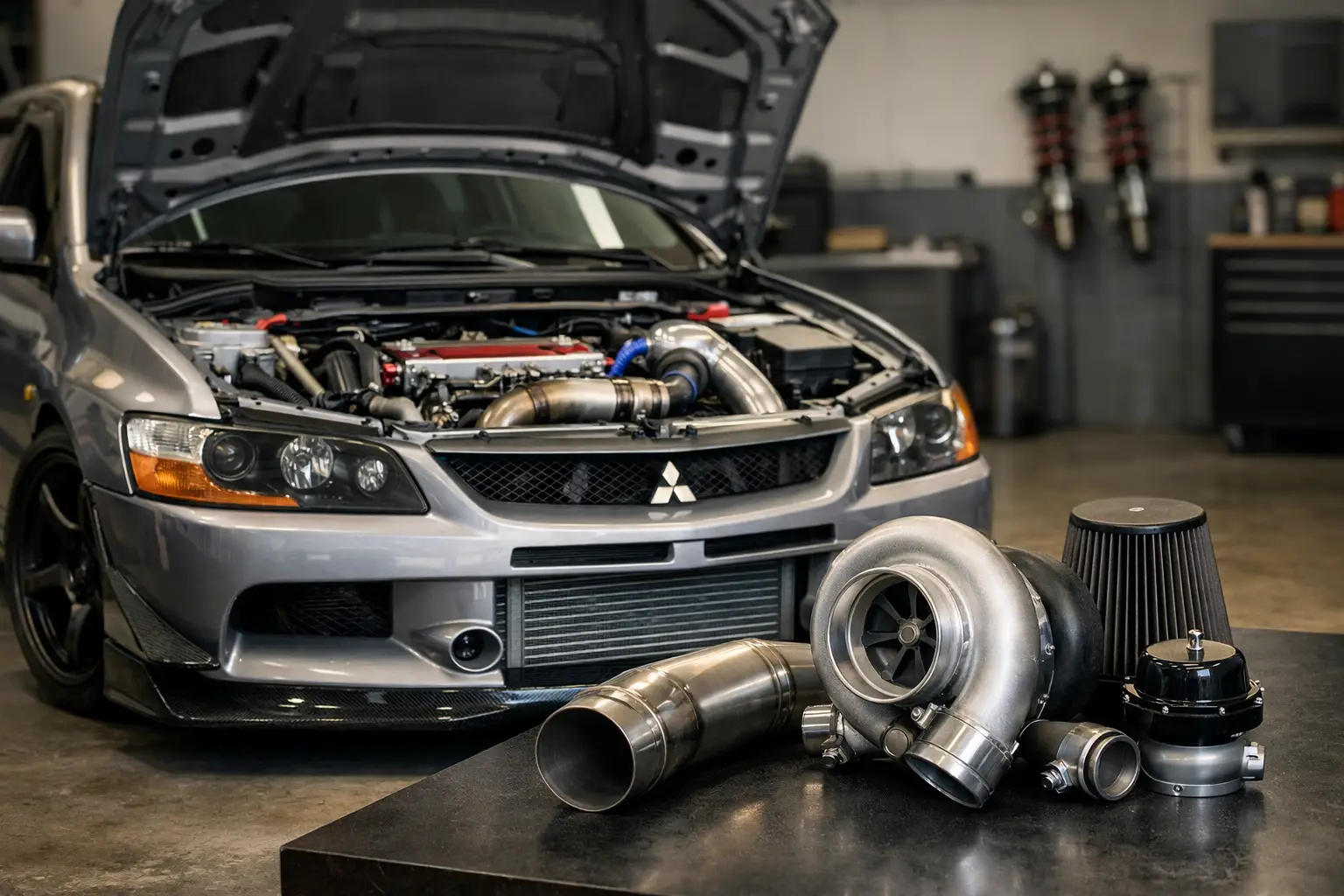
Evo 9 Big Turbo Mods That Actually Matter
The fastest way to ruin an Evo 9 big turbo setup is treating the turbo like the whole build.
A bigger turbo can make great power on the 4G63, but the turbo itself is only the headline. The supporting mods decide whether the car is sharp, reliable, and actually fun to tune – or a constant problem with knock, heat, clutch slip, and fuel limits showing up right when boost comes in. If you want a real evo 9 big turbo supporting mods guide, start by thinking in systems, not parts.
What changes when you go big turbo on an Evo 9
The Evo 9 responds well to turbo upgrades because the platform already has strong fundamentals. The MIVEC 4G63 is flexible, the aftermarket is deep, and the chassis can handle serious power. But once you move beyond a basic bolt-on turbo and start pushing airflow hard, every weak link becomes more obvious.
Fuel demand rises fast. Intake and intercooler restrictions start costing power. Oil and coolant temps matter more. The stock clutch usually becomes a countdown timer. Even the tune gets less forgiving because a bigger turbo changes how the car builds boost, where it makes torque, and how sensitive it is to injector sizing, fuel quality, and backpressure.
That is why the right supporting setup matters more than chasing a compressor map screenshot.
The evo 9 big turbo supporting mods guide starts with fuel
If the fuel system is undersized, stop there. No intercooler pipe, boost controller, or fancy manifold fixes a fuel system that cannot keep up.
For most Evo 9 big turbo builds, injectors and fuel pump are the first non-negotiables. Injector size depends on the fuel you plan to run. A pump gas street car aiming for responsive midrange power has very different needs than an E85 setup chasing higher boost and more headroom. Many owners make the mistake of buying injectors for their current tune instead of their next one. That usually means paying twice.
Fuel pump choice also needs context. A drop-in pump can be enough for moderate goals, but once power climbs, the entire fuel delivery path matters. That includes wiring, pump voltage, the fuel pressure regulator, and in some cases the rail and lines. If base fuel pressure is unstable or pressure drops at high load, the tune becomes a compromise.
E85 changes the conversation even more. It gives the 4G63 excellent knock resistance and cooling, but it requires much more fuel volume. If you are planning flex fuel or full E85 later, build the fuel system around that now. It is cheaper than replacing undersized parts after the turbo is already installed.
ECU and tuning are part of the fuel system
On an Evo 9, tuning is not an afterthought. It is part of the hardware package.
ECU calibration needs to match injector scaling, fuel type, boost control strategy, and the turbo’s airflow behavior. A big turbo car with a lazy or overly aggressive tune will feel worse than a smaller setup that is calibrated properly. Good tuning also protects the engine by keeping knock under control, managing boost by gear if needed, and smoothing out drivability at part throttle.
If the goal is a streetable car, tell your tuner that before you buy parts. Peak dyno numbers are easy to advertise. A powerband that comes in predictably, keeps temps under control, and survives repeated pulls is what actually makes the car quicker and more enjoyable.
Airflow mods that support the turbo, not fight it
A big turbo cannot perform if the engine still has to breathe through restrictive hardware.
Start with the intake side. A properly sized intake, quality filter, and turbo inlet setup help the turbo spool and reduce unnecessary restriction. The intercooler and piping matter just as much. Once airflow increases, charge temps rise, and a marginal intercooler becomes a real limitation. That shows up as heat soak, timing being pulled, and inconsistent power from one pull to the next.
Exhaust flow is the other half of the equation. A high-flow downpipe and exhaust system reduce backpressure and let the turbo operate more efficiently. Depending on the turbo choice and power target, the exhaust manifold and O2 housing can also become worth upgrading. But this is one of those areas where it depends. On a moderate street setup, the factory manifold can still work well. On a higher-output build where response and top-end flow both matter, stepping up the manifold may make sense.
What does not make sense is choosing parts on noise or appearance alone. The Evo 9 rewards balanced airflow. Oversized parts without a clear goal can hurt response and make tuning touchier than it needs to be.
Cooling is not optional on a hard-driven Evo 9
Big turbo power means more heat everywhere.
That starts with charge air temps, but it does not end there. Engine coolant temperatures, oil temperatures, and underhood heat all rise when the car is pushed hard. A street car that only sees short pulls can get away with less than a track-day or roll-race setup, but every big turbo Evo should have a real cooling plan.
A quality aluminum radiator is one of the smartest upgrades on this platform. Pair that with healthy cooling fans, good coolant hoses, and a properly functioning thermostat. Oil cooling becomes more important as boost and sustained load increase. If the car sees repeated highway pulls, hot weather driving, or track use, an oil cooler setup starts moving from nice-to-have to necessary.
Heat management around the turbo also helps. That can mean a turbo blanket, heat shielding, and paying attention to nearby lines and components. Reducing underhood heat improves consistency and protects the parts around the turbo, not just the turbo itself.
Drivetrain and clutch upgrades keep the build usable
A big turbo Evo 9 that slips the clutch in fourth gear is not finished.
The clutch needs to match the torque curve and the way you use the car. Some aggressive clutch setups hold great power but make street driving miserable. Others feel civil but do not survive repeated hard launches or high-boost pulls. The right answer depends on whether the car is a daily driver, a weekend street build, or something that sees regular drag or track use.
Flywheel choice plays into that too. Lightweight flywheels can improve response, but they also change drivability. Some owners love the sharper feel. Others get tired of the more abrupt behavior in traffic. There is no universal best choice here.
Beyond the clutch, inspect the rest of the drivetrain honestly. Worn mounts, tired bushings, and old fluids show up quickly once torque rises. Transfer case, rear diff, and transmission health matter. So do axles if the car launches hard. Supporting mods are not only about adding performance parts. Sometimes they mean replacing worn OEM pieces before they become failures.
Boost control, sensors, and small parts matter more than people think
This is where a lot of big turbo builds get sloppy.
A reliable boost control solenoid, accurate MAP and wideband data, fresh vacuum lines, and good couplers are not glamorous purchases, but they affect the tune every time you drive the car. A boost leak or unstable control signal can waste hours of dyno time and make the car feel inconsistent on the street.
The same goes for spark. Colder plugs may be appropriate depending on boost and fuel, and ignition health matters on a high-cylinder-pressure setup. Coils, plugs, and basic maintenance should not be an afterthought when the rest of the build is getting serious.
The smart way to build an Evo 9 big turbo setup
The best evo 9 big turbo supporting mods guide is not really a shopping list. It is a build order.
Start with a realistic power goal and fuel choice. Then size the fuel system, choose the turbo, and build the airflow path around it. After that, handle cooling, clutch, and drivetrain reliability. Finish with the sensors, boost control, and tuning details that make the package work together.
If you buy parts in reverse order, you usually spend more and get worse results. A car with the right turbo and the wrong support mods feels unfinished. A car with a balanced setup feels like Mitsubishi should have built it that way from the start.
At Evo Motor Parts, that is how we look at these builds – not as random catalog upgrades, but as systems that need to work together under real load.
Build for the power you want next season, not the dyno number you want this weekend.