
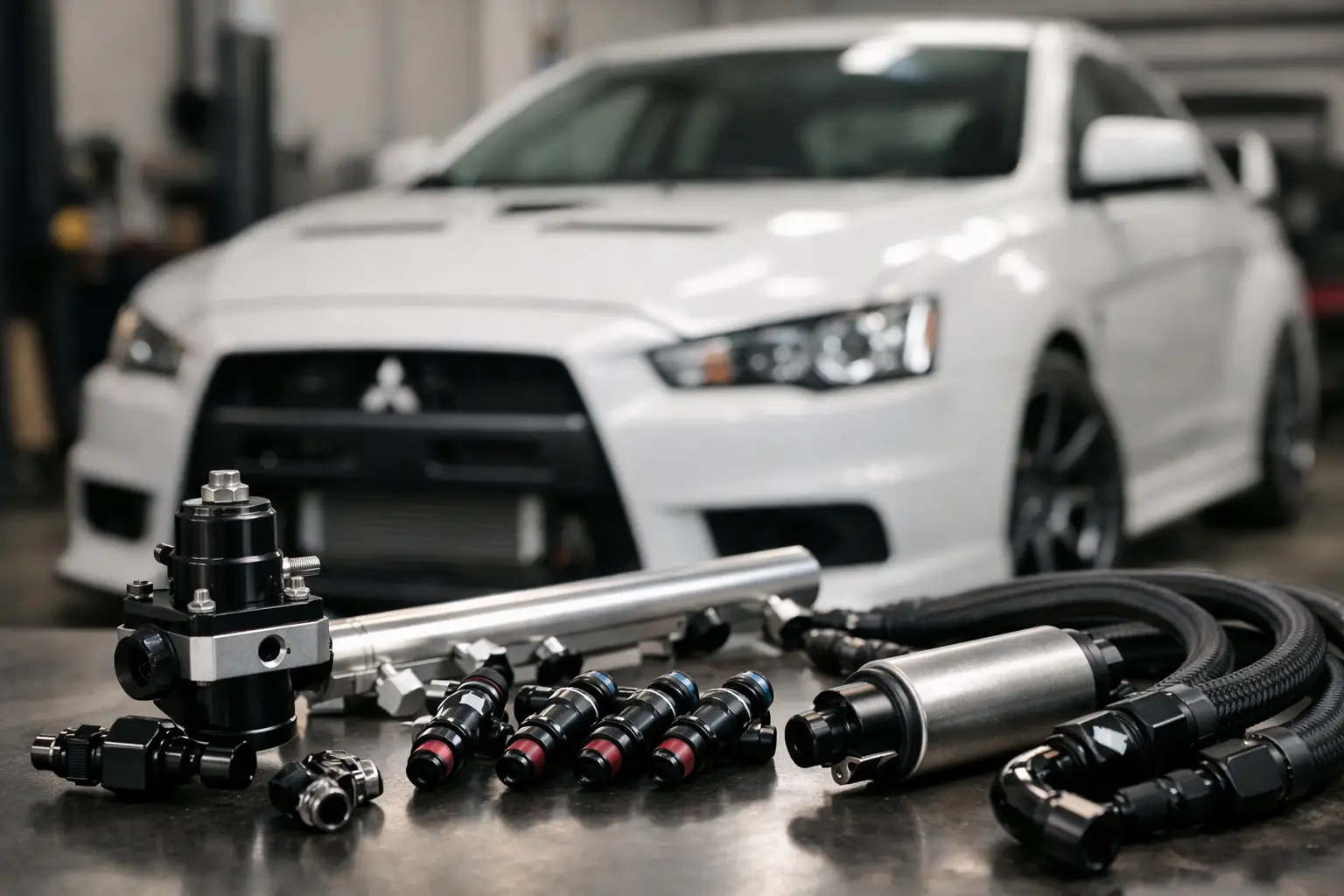
Evo X Fuel System Upgrade Guide
The stock Evo X fuel system holds up better than a lot of people expect – right up until your tune, turbo, or ethanol mix asks for more than the factory parts can deliver. That moment usually shows up as injector duty climbing too high, fuel pressure falling off up top, or a tuner telling you the setup is already at its limit before the car ever sees full potential.
That is where a smart plan matters. Fuel upgrades on the Evo X are not about throwing the biggest pump and injectors at the car. They are about matching components to your power goal, your fuel choice, and the way the car is actually used. A street car on pump gas needs a different strategy than a flex-fuel weekend warrior or a track-focused setup that lives at sustained load.
Evo X fuel system upgrade guide for real build goals
The best Evo X fuel system upgrade guide starts with one rule: build around horsepower target and fuel type, not hype. Pump gas, E blends, and full E85 all change how much fuel volume the engine needs. Ethanol makes great power and adds knock resistance, but it also demands significantly more fuel than gasoline. That means a setup that looks fine on 93 octane can become undersized the second you switch fuels.
For a lightly modified Evo X with bolt-ons and a stock-frame turbo, you can often get away with a modest injector and pump upgrade. Once you move into larger turbo territory or commit to E85, the margin disappears fast. That is when you need to think about the whole system – injectors, in-tank pump, wiring, pressure control, lines, and tune.
The mistake we see most often is buying parts in isolation. A big injector set without proper pump support will not save a lean setup. A high-flow pump without the right calibration can create drivability problems at idle and cruise. Fueling needs to work as a package.
Start with your power target and fuel choice
If your goal is a responsive street Evo X making moderate power on 91 or 93 octane, the stock system can sometimes stretch farther than expected with careful tuning, but there is no reason to live on the edge. A mild upgrade path gives your tuner more room and keeps injector duty and pump load in a safer range.
If the plan includes E60 to E85, the conversation changes immediately. Ethanol is excellent for the 4B11T when the supporting system is there, but it is unforgiving when it is not. You need enough injector and pump capacity for worst-case demand, not best-case dyno weather.
For most owners, it helps to think in three tiers. A basic bolt-on car needs headroom. A bigger turbo street build needs a complete fueling plan. A serious E85 or track car needs fuel delivery that stays stable under sustained heat and load. Those are different jobs, and the parts list should reflect that.
Injector sizing is not the place to guess
Injectors need to support your target power with margin, but oversized injectors are not automatically better. On older setups, going too large could make low-load behavior messy. Modern tuning has improved that, and the Evo X ECU can handle larger injectors well when scaling and latency data are correct, but quality still matters.
Choose injectors from proven manufacturers with accurate characterization data. That matters as much as the flow rating. A well-calibrated set with solid data will drive better, tune faster, and make the car more predictable than a bargain set that only looks good on paper.
If you are planning future turbo and ethanol upgrades, it usually makes sense to buy injectors once and size them for the end goal. If the car will stay on pump gas with a modest setup, do not overspend chasing capacity you will never use.
The fuel pump does more than support peak horsepower
An upgraded in-tank pump is one of the most common Evo X fueling mods, and for good reason. The factory pump can become a restriction once airflow and fuel demand rise. But flow numbers alone do not tell the whole story. Real pump performance depends on voltage, base pressure, fuel type, and how the pump behaves under load.
This is why pump rewiring is often part of the conversation. A quality rewire helps the pump see consistent voltage, which improves performance and reduces the gap between advertised flow and what the car actually gets. On a car that is already close to the limit, that difference is not minor.
You also need to think about fuel temperature and long pulls. A setup that survives one dyno sweep is not necessarily a setup that stays stable on a road course or during repeated high-speed runs. Reliability under sustained demand is the standard, especially on an Evo X built to be driven hard.
When the stock lines and regulator become part of the problem
Not every Evo X build needs rails, lines, and a regulator right away. For many street cars, an upgraded pump and injectors are enough. But there is a point where the rest of the system matters, especially with larger pumps, ethanol use, or higher horsepower goals.
If fuel pressure control becomes inconsistent, or your tuner is fighting pressure drop at the top end, the supporting hardware may be the next bottleneck. Larger lines and an aftermarket fuel pressure regulator can improve stability and make the system easier to tune. Aftermarket rails can also help, though they should be chosen for actual function and fitment, not just engine bay appearance.
This is one of those it-depends areas. Some builds absolutely need a return-style conversion. Others do not. The right answer depends on your power level, your fuel, and whether you value room to grow more than minimum initial cost.
Return-style systems – worth it or overkill?
A return-style setup is the clean answer once your Evo X moves beyond basic fueling upgrades. It gives you better pressure control, better support for high-flow pumps, and more confidence on ethanol-heavy builds. It is also the more expensive and involved route.
For a lot of owners, that trade-off is worth it because it turns the system into something predictable. Tuning gets easier. Fuel pressure behavior gets more consistent. Future upgrades stop stacking compromises on top of stock hardware that was never designed for that level of demand.
But not every build needs it. If your car is a fast street setup on pump gas or a conservative ethanol blend with reasonable power goals, a full return system may be more than you need right now. There is nothing wrong with building in stages as long as each stage still has enough margin to be safe.
Do not ignore the tune
No fuel system upgrade works without calibration that matches the hardware. Injector data, pump behavior, fuel pressure assumptions, and ethanol content all affect the tune. Even excellent parts can create poor drivability or unsafe air-fuel ratios if the calibration is rushed or based on bad data.
This is especially true with flex-fuel or E85 setups. The car needs to be tuned for the actual system installed, not a rough approximation. If the tune is not right, cold starts, idle quality, transient response, and high-load safety all suffer.
The Evo X responds extremely well when the hardware and tuning strategy agree with each other. That is the goal. Clean cold starts, stable trims, predictable fuel pressure, and enough headroom to let the turbo and ignition strategy work without gambling the engine.
Common mistakes in an Evo X fuel system upgrade guide
The big ones are always the same. People underestimate ethanol fuel demand. They buy parts with no clear power goal. They skip wiring support for the pump. They choose cheap injectors with poor data. Or they assume a dyno number means the system is safe everywhere.
Another common issue is planning for the current setup instead of the next one. If a turbo upgrade is six months away, buying a barely adequate fuel system now usually means paying twice. On the other hand, going too far too soon can waste money and complicate a straightforward street build.
That is why platform-specific parts selection matters. Fitment, electrical compatibility, and real Evo X tuning experience make the difference between a clean install and a frustrating one. Shops that actually know this chassis tend to recommend combinations that work together, not random parts that happen to share a category.
If you are building the car with long-term reliability in mind, source components from specialists who know Evo fitment and support proven combinations. That is exactly why owners come to Evo Motor Parts – to cut out the guesswork and build with parts that are tested, trusted, and chosen for real-world Evo use.
Build the fuel system for the car you actually want
The right fuel setup is the one that supports your power goal with margin, drives cleanly, and does not become the weak link the first time you lean on the car. For some Evo X owners, that means injectors and a pump with proper tuning. For others, it means going straight to a return-style system because the end goal already justifies it.
If you treat fueling like a complete system instead of a parts pile, the rest of the build gets better. Tuning gets easier. Power delivery gets more consistent. And you spend more time driving the car hard instead of chasing fuel-related problems that could have been avoided from the start.
Build it once, size it honestly, and leave yourself room for the next round of boost.


