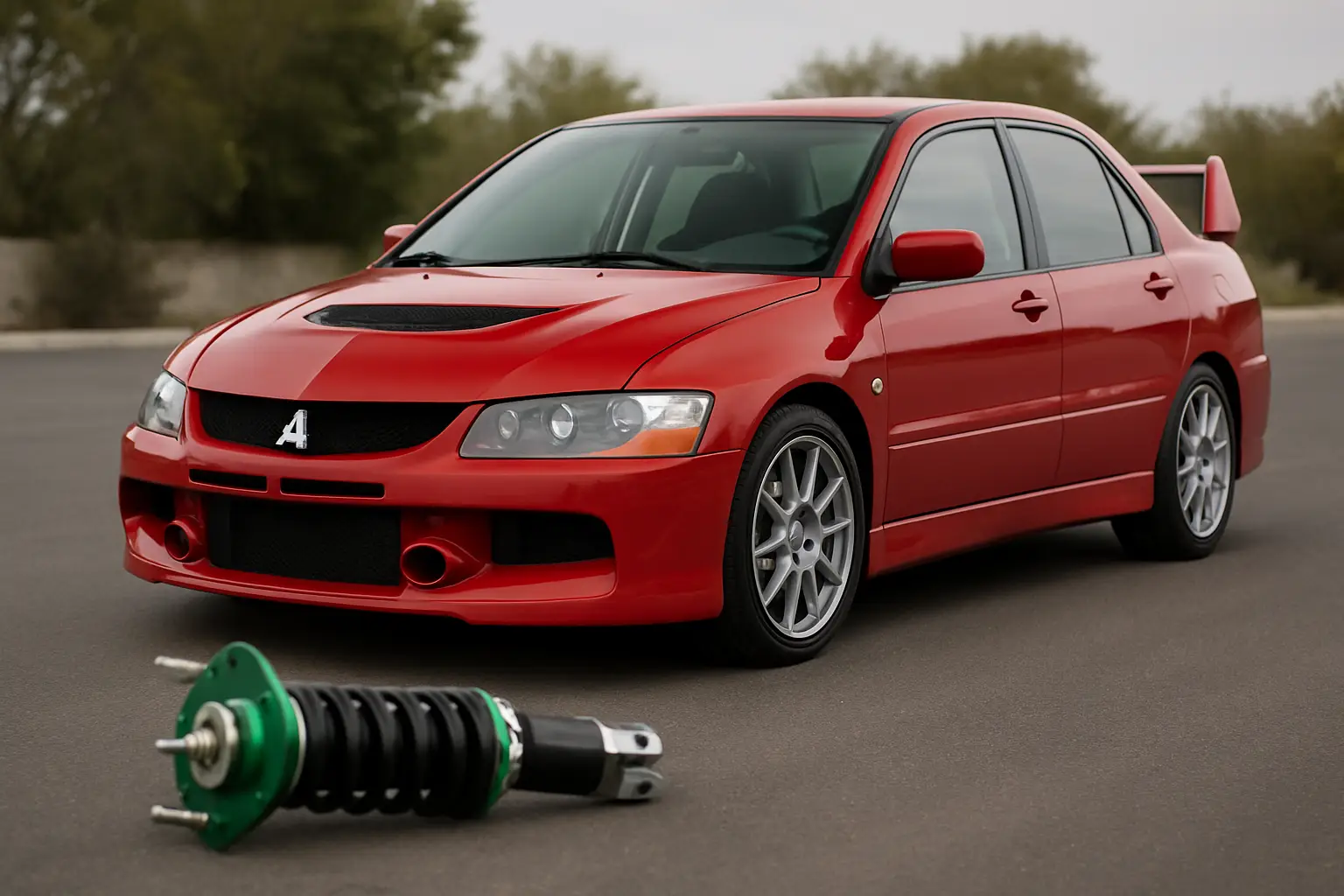
Best Evo 9 Coilovers for Street Driving
You can feel a bad coilover in the first 200 feet – the car chatters over expansion joints, skips mid-corner, and suddenly your “street build” has the ride quality of a shopping cart. On an Evo 9, that mistake also costs traction. The chassis is stiff, the tire is usually stiff, and the AWD system rewards compliance. Street coilovers are not about going low. They’re about keeping the tire loaded while you drive the car hard on real roads.
This is how we think about the best evo 9 coilovers for street: the ones that ride with control, survive daily use, and still give you enough adjustment to dial out the factory understeer without turning the car into a pogo stick.
What “street” really means on an Evo 9
Most Evo 9s live a split life: commuting, weekend canyon runs, and maybe a few track days a year. That mix changes what “best” means.
For daily driving, the priority is damper quality, not spring rate. A well-valved damper can run a reasonable spring and still feel planted. A cheap damper on an aggressive spring feels harsh, then gets worse as it heats up and wears.
For spirited street driving, you want support in transitions and mid-corner stability without making the car skittish over imperfect pavement. The Evo’s front weight bias and MacPherson strut front geometry also mean you can’t “alignment your way” out of everything. A coilover that controls roll and pitch properly is the difference between confidence and constant correction.
For “street plus track day,” you need heat tolerance and consistent damping. That doesn’t automatically mean going to the stiffest setup. It means choosing a damper that stays predictable when driven hard and doesn’t blow seals after two seasons.
The street coilover checklist that actually matters
If you’re shopping based on ride height range and number of clicks, you’re already drifting off target. Here’s what moves the needle on an Evo 9.
Damper design and valving quality
Monotube vs twin-tube isn’t a religion, but it is a clue. Monotubes tend to offer better response and heat management, which helps when you drive the car like an Evo. Twin-tubes can ride very well if the valving is right. Either way, you’re paying for piston design, shim stack development, and consistency between corners.
The best street coilovers feel calm at low shaft speeds (cruising, small bumps) and controlled at higher shaft speeds (potholes, sharp impacts). That’s the “rides firm but not harsh” feeling everyone wants, and it comes from valving, not marketing.
Spring rates that match your roads and tires
Spring rate is a tool, not a flex. On the street, too stiff reduces grip because the tire can’t follow the surface. If you’re on 17s with a little sidewall, you can get away with more spring than a 18-inch wheel with a thin tire, but the principle stays the same.
For most street-focused Evo 9s on typical performance tires, you’re usually happiest in a moderate range. If you’re mainly commuting with occasional spirited driving, softer is faster because it keeps the contact patch working.
Adjustment you can use, not adjust “because you can”
Damping adjusters matter when the adjustment range is usable and repeatable. One knob that changes rebound and compression together can still work well if the manufacturer tuned it for the car. Independent compression and rebound is great for advanced tuning, but it also makes it easier to get lost.
If you don’t have a baseline and you don’t want to spend Saturdays chasing clicks, prioritize a coilover known for good out-of-the-box street tuning.
Real-world durability and serviceability
Street cars see salt, rain, dirt, and heat cycles. Look for corrosion-resistant bodies, quality seals, and rebuild support in the US. A coilover you can rebuild is almost always a better long-term buy than one you throw away.
Best Evo 9 coilovers for street: proven options and who they fit
There isn’t one “best” for everyone. There are a few clear winners depending on how you drive, how low you want to go, and how much you care about ride quality versus adjustability.
Ohlins Road & Track: the street king for people who drive
If your definition of street is “I want it to ride better than stock but handle like it’s on rails,” Ohlins Road & Track is hard to beat. The dampers are the story here – they control motion without punishing the chassis, and they stay consistent when you start pushing.
On an Evo 9, this typically translates to a car that feels more planted over broken pavement, with less mid-corner correction. You also get a setup that doesn’t need extreme spring rates to feel sharp, which is exactly what you want for traction on real roads.
Trade-off: you’re paying for engineering, and you’re usually not buying this setup to park the car slammed. If you want ultra-low ride height, choose something designed for that and accept the geometry compromises.
KW Variant 3: dialed street comfort with serious control
KW V3 is a strong pick if you care about ride quality and want tuning range without going full race coilover. Independent rebound and compression adjustment gives you room to tailor the car to your tire, wheel, and road conditions.
The “KW feel” on the street is composed and mature – the suspension moves, but it doesn’t float. For an Evo 9 that sees daily miles, that’s a win. It also plays nicely with a street alignment where you’re not chasing maximum camber.
Trade-off: if you don’t plan to tune, you’re paying for adjustment you might not use. Also, if you run very aggressive spring rates later, you’ll be outside the comfort zone the kit was designed around.
Bilstein-based kits (PSS/PSS9 style): classic control, great value when matched right
Bilstein dampers have a reputation for a reason: predictable response and solid durability. On the Evo 9, a Bilstein-based coilover can be the “set it and forget it” option that still drives like a performance car.
This category is especially attractive if you want a street setup that doesn’t feel delicate. If you’re the type who drives in all seasons or puts real mileage on the car, a durable damper matters.
Trade-off: depending on the exact kit, you may have less fine adjustment than the premium multi-way options, and spring rate choices can be more limited. You’re buying a tuned system, not a tuning platform.
Fortune Auto (ex: 500 series): street-friendly with rebuild and custom options
Fortune Auto has earned a strong following because they bridge the gap between daily comfort and track capability, and they offer rebuilds and customization. For Evo owners who want a coilover that can evolve with the build – different springs, revalve options, future changes in use – this is a practical route.
A properly spec’d Fortune Auto setup can ride very well on the street, especially when you’re honest about spring rates and don’t chase stiffness for Instagram points.
Trade-off: because there are options, outcomes depend on what you choose. If you order an overly aggressive spec, you can build yourself a harsh car. The upside is you can also fix it.
Budget coilovers: when “good enough” stops being good
Yes, you can buy cheaper coilovers that bolt on and go low. But the Evo 9 is not forgiving when damping quality is poor. The car will feel busy, you’ll fight traction over bumps, and you’ll end up turning the knobs randomly trying to solve a valving problem you can’t click away.
If the goal is the best evo 9 coilovers for street, most budget options miss the point. They’re about ride height and a price tag, not keeping the tire working at speed.
How to spec an Evo 9 street setup without ruining it
Start with your real use case. If you commute and do weekend pulls on backroads, keep spring rates moderate and prioritize damper quality. Pair that with a conservative drop – enough to clean up the wheel gap, not enough to destroy travel.
If you run wider tires and a more aggressive alignment, you can add a little spring to support the tire, but don’t jump straight to “track rates” unless the car lives on smooth pavement. The fastest street Evo is usually the one that can put power down over ugly asphalt.
Also, don’t ignore bump stops and travel. A lot of “harsh coilover” complaints are really “I lowered it too far and now I’m on the bump stops.” Travel is grip.
Supporting mods that make coilovers feel better
A great coilover can still feel wrong if the rest of the chassis is fighting it. Worn top hats, tired bushings, and sloppy endlinks will make any suspension feel noisy and inconsistent.
If your Evo 9 still has original rubber, refreshing key suspension bushings and using quality sway bar endlinks can make the car feel tighter without increasing harshness. And if you’re chasing front-end bite, a proper alignment with enough front negative camber matters as much as the coilover itself.
One more reality check: if you go very stiff on engine mounts and drivetrain mounts, you may blame the coilovers for vibrations that are actually coming from the powertrain. Street comfort is a system, not one part.
The quick way to choose the right “best”
If you want the best ride quality and control for an Evo 9 that’s driven hard on real roads, Ohlins Road & Track is the benchmark. If you want a comfort-first performance setup with meaningful tuning range, KW V3 is a strong move. If you want durable, predictable performance with a more straightforward approach, a Bilstein-based kit is hard to argue with. If you want flexibility, rebuild support, and the ability to tailor the setup as your build changes, Fortune Auto is a smart street-plus option.
If you want help matching coilovers to your exact Evo 9 goals and supporting suspension parts, that’s the kind of fitment-first guidance we build around at Evo Motor Parts (https://evomotorparts.com/).
The best street coilover isn’t the one with the most hype. It’s the one that keeps your tires planted when the road gets ugly and still makes you look for excuses to take the long way home.