Evo X Throttle Controller: Response, Setup & Safety
Sharper response without confusing sensitivity for horsepower
An Evo X throttle controller changes how quickly the throttle reacts to your right foot. The useful part is adjustability—not a promise of added engine power.
What an Evo X throttle controller actually does
The accelerator in an Evo X is electronic. Your pedal position becomes a signal, and the engine-control system decides how to respond. A plug-in controller sits in that signal path and changes the relationship between pedal movement and requested throttle. In a sharper mode, a small pedal movement can feel more immediate. In a reduced-response or economy-style mode, the same movement can feel gentler.
That distinction matters. A more aggressive map may make the car feel livelier in normal driving, but it does not add airflow capacity, fuel-system capacity or calibrated boost. Think of it as changing the curve of the pedal, not increasing the engine’s ceiling. Owners planning actual power changes should treat tuning, fuel quality and supporting hardware as a separate project.
Is a throttle controller right for your Evo X?
A controller is easiest to evaluate on a mechanically healthy car with predictable throttle behavior. It can also complement thoughtful interior upgrades because the control unit is compact and removable. For a broader look at practical cabin and usability upgrades, see our guide to Evo accessories that actually improve the car.
Fitment checks before ordering
- Confirm the product application matches your exact Evo X model year, transmission and market.
- Compare the supplied harness connector with the factory accelerator-pedal connector before installation.
- Check whether another piggyback device, remote-start system or aftermarket alarm shares nearby wiring.
- Plan a controller location that is visible when parked but cannot obstruct the pedals, steering column or knee-airbag area.
- Read the manufacturer’s current setup and calibration instructions; connector fit alone is not proof of full compatibility.
Injen X-Pedal Throttle Controller for Evo X
The listed Injen X-Pedal PT0006B is a convenient starting point for Evo X owners researching selectable throttle response. Review the live product details and confirm your exact application before purchase.
View the Evo X throttle controllerA careful installation sequence
1. Park, power down and make the work area safe
Park on level ground, apply the parking brake and keep the key away from the vehicle. Let the electronics settle before disconnecting anything. Remove loose floor mats and make sure lighting is good enough to inspect the pedal connector without pulling on the wires.
2. Release the factory connector by its lock
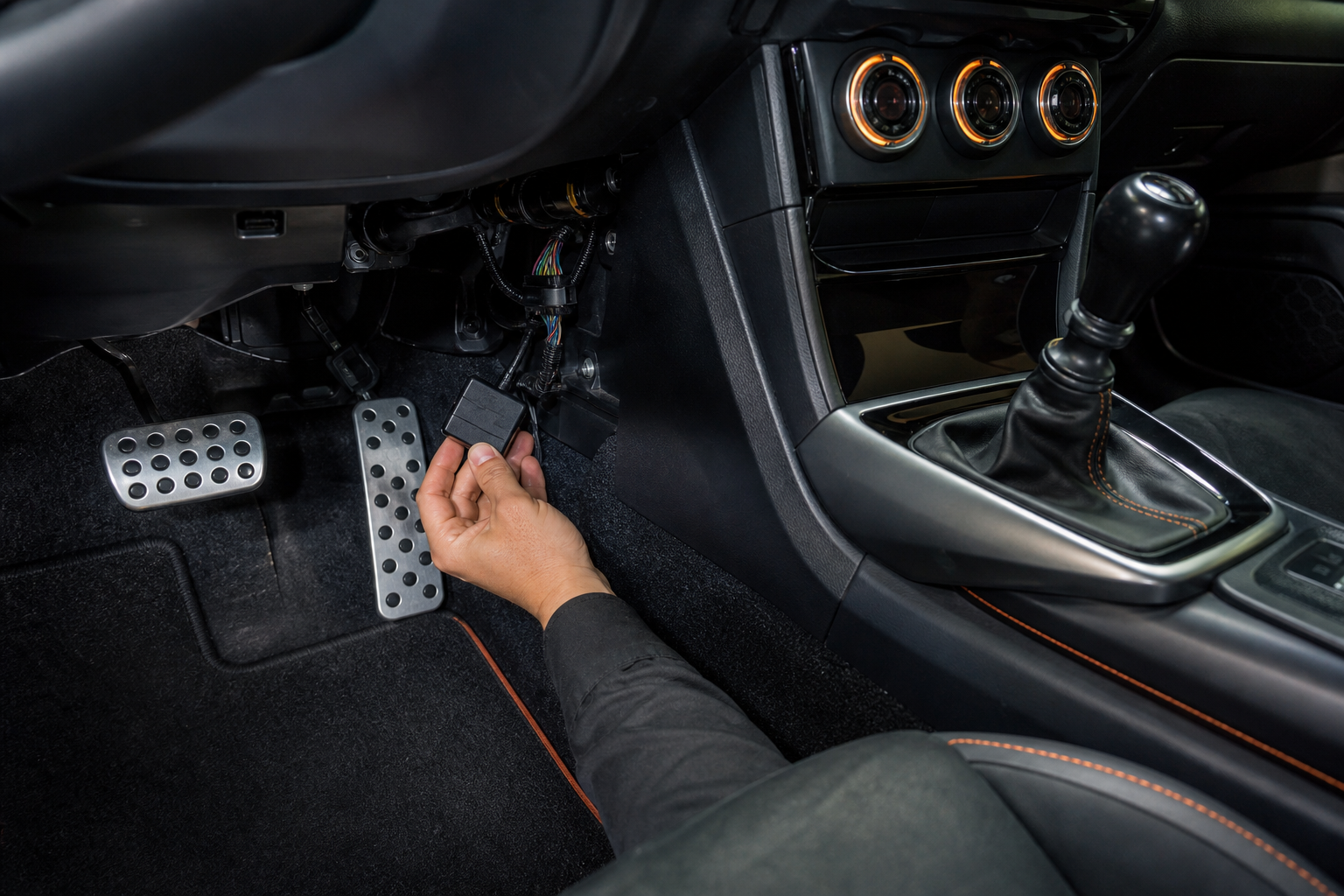
Reach the accelerator-pedal connector without forcing the harness. Depress the locking tab and pull on the connector body, not the wires. If access is awkward, improve access rather than prying the plug. Bent pins, a half-seated connector or a damaged lock can cause a throttle fault.
3. Install the inline harness and secure it
Connect the controller harness between the factory loom and pedal assembly exactly as instructed. Listen or feel for each connector lock. Route excess wire away from the pedal arm, brake pedal, steering shaft, sharp brackets and heater movement. Secure the cable without stretching it.
4. Mount the display without creating a hazard
Clean the mounting surface and place the control unit where it can be checked while the car is stationary. Do not mount it over an airbag cover, directly in a crash contact area or where a cable can drop into the footwell.
First startup and safe setting selection
Before driving, sit in the normal position and press the accelerator through its full travel with the engine off. Confirm the pedal returns freely and no wiring moves. Start the car and let it idle. If a warning light appears, the idle is abnormal or the car enters a reduced-power mode, switch off and recheck every connection. Do not try to “drive through” an electronic throttle fault.
Begin with the stock-like or mildest response mode. Test at low speed in a dry, open, traffic-free area, building pedal input gradually. A setting that feels exciting in a car park can be abrupt in rain or stop-and-go traffic. The best setting is the one that lets you place torque smoothly, not the highest number on the display.
Common mistakes that create poor results
- Expecting the controller to fix turbo lag, boost leaks or a weak engine.
- Choosing the most aggressive mode before learning the new pedal curve.
- Leaving a cable loose near the pedal or trapping it behind trim.
- Installing over an existing throttle or pedal fault.
- Skipping a post-installation scan after a warning light appears.
When to remove it and diagnose
Stop using the controller if throttle response becomes inconsistent, the pedal does not return normally, a warning light appears, the engine enters limp mode or acceleration does not match your input. Park safely, switch off and return the car to the original connection if the instructions permit. Persistent faults need proper diagnosis with a compatible scan tool; do not assume the controller is the only possible cause.
Choose control, not maximum sensitivity
A well-installed Evo X throttle controller can make everyday response feel more direct. Verify fitment, protect the factory wiring, begin gently and keep the setting appropriate for surface conditions. That approach delivers the useful part—predictable response—without turning pedal sensitivity into a safety problem.
Check current product details